Japonics / COMMUNITY PLATFORM
NAKAMA
A community platform for fandoms, clubs, and groups, connecting profiles, events, memories, activities, and private relationships.
Client:
Japonics
Year:
2026
Trust architecture: KYC and encryption
Where the project started
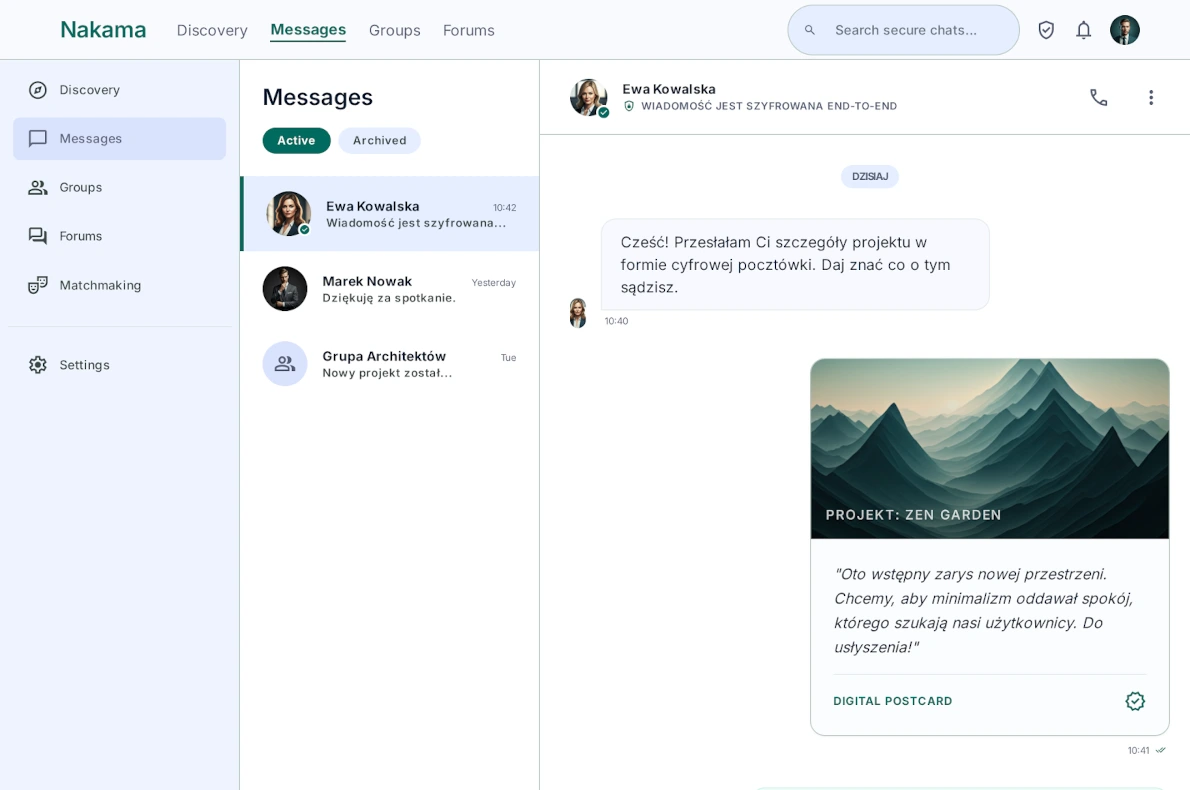
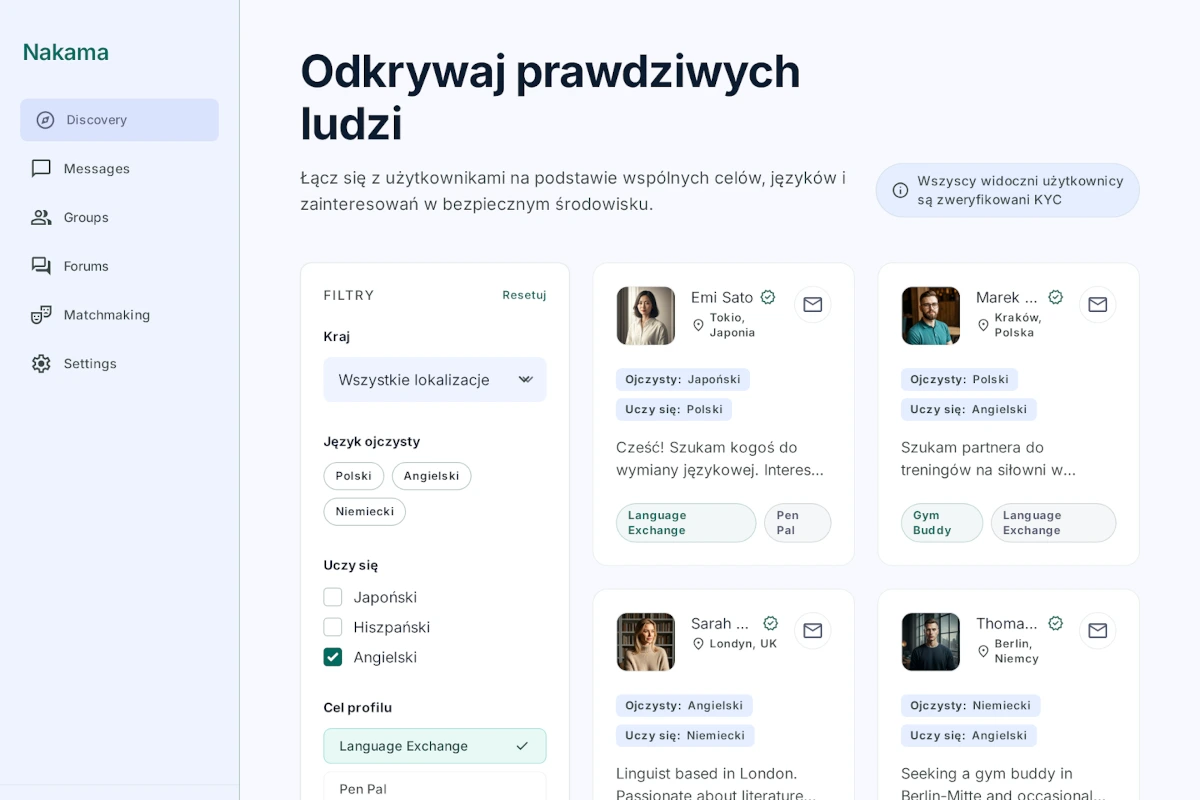
Nakama designs trust as architecture, not a terms-of-service promise: mandatory identity verification, a paid-only onboarding with no free tier, and end-to-end encrypted chat remove whole classes of spam, bots, and fake profiles before they ever reach discovery.
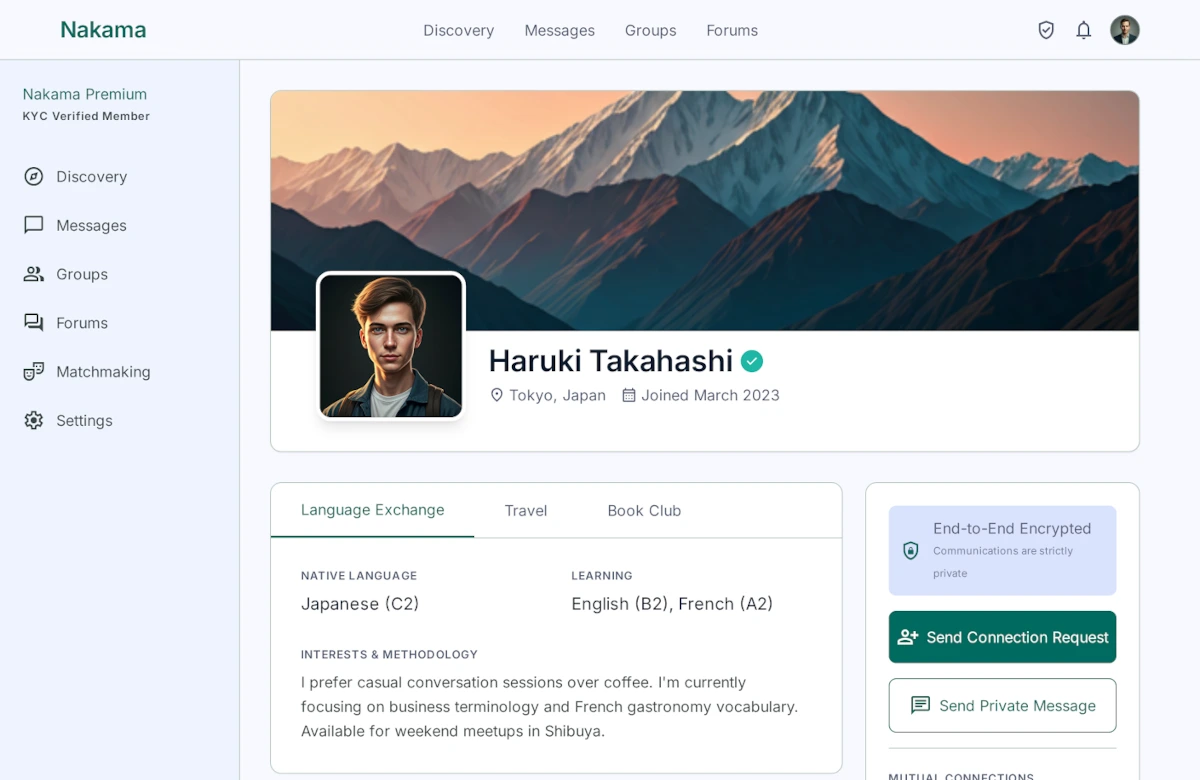
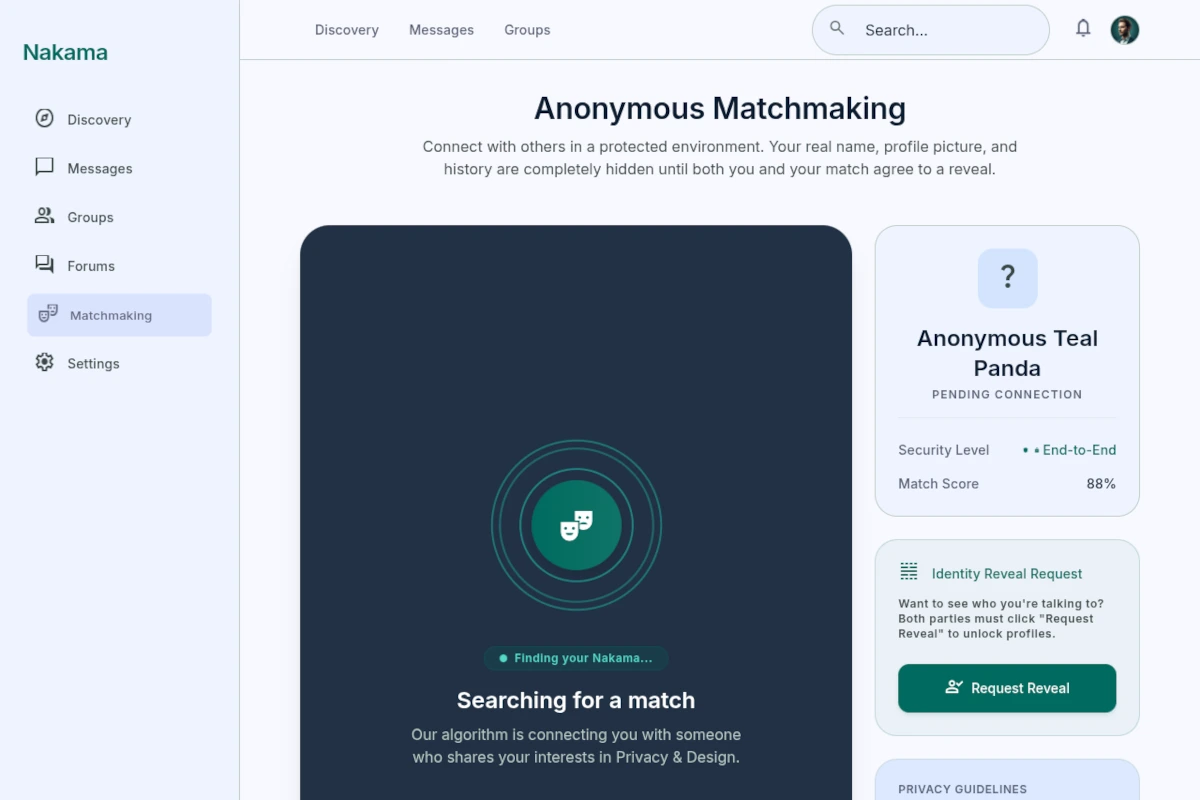
Nakama is built around private contexts: groups, events, side quests, media, relationships, and permissions, with mandatory KYC and end-to-end encrypted chat (the server only ever sees ciphertext) as the trust foundation, not an add-on. The architecture separates public profiles, private memories, and organizer operations.
Business / Product
Problems and solutions
Each tile connects a real product tension with the decision that clarified the domain, UX, or operations.
Problem
Communities often fall back to chaotic chats, feeds, and spreadsheets, losing the history of relationships and events.
Solution
Design a mature community model that does not clone a public social network.
Outcome
Clear alternative to chaotic chats
Problem
The scope could easily become a feature list without one product, data, and ownership model.
Solution
Nakama is built around private contexts: groups, events, side quests, media, relationships, and permissions, with mandatory KYC and end-to-end encrypted chat (the server only ever sees ciphertext) as the trust foundation, not an add-on. The architecture separates public profiles, private memories, and organizer operations.
Outcome
Roles and privacy as product foundations
Problem
The project needed decisions that would stay readable after the first version: for users, the team, and further delivery.
Solution
Roles and privacy as product foundations. Mandatory KYC and paid onboarding with no free tier.
Outcome
Model ready for community-led growth
Roles and competencies
The competencies this build required
Competencies are shown as ownership roles: CTO, Tech Lead, engineering, DevOps, cloud, security, and AI where they were part of the work.
01
Fractional CTO
Connecting the product thesis, domain risk, and priorities so technology supports business decisions instead of becoming a separate workstream.
Open competency
Scope
- Product category and positioning
- Scope priorities and risk
- Decisions ready for founder or CTO review
Applied experience
- Product thesis translated into technical priorities.
- Risks framed in a language stakeholders can review.
02
Tech Lead
Shaping responsibility boundaries, domain modeling, and architecture decisions so the project can grow without drifting into an accidental monolith.
Open competency
Scope
- Bounded contexts and ownership
- Readable technical decisions
- Roadmap without implementation chaos
Applied experience
- Domain boundaries and decisions that remain reviewable after MVP.
- Ownership model readable for later delivery stages.
03
Software Engineer
Turning the domain into screens, APIs, flows, and maintainable implementation with focus on clarity and post-MVP evolution.
Open competency
Scope
- Backend and application contracts
- UX surfaces ready for iteration
- Code and maintenance model
Applied experience
- Implementation tied to the real product workflow.
- Contracts and code prepared for post-launch iteration.
04
DevOps Engineer
Designing delivery, observability, and operations so release, diagnostics, and recovery are part of the product.
Open competency
Scope
- CI/CD and release readiness
- Observability and production signals
- Operations without manual rituals
Applied experience
- Release, diagnostics, and recovery designed as product capabilities.
- Production signals ready for maintenance without guessing.
05
Cloud Engineer
Choosing cloud, data, and integration foundations so scale, cost, and reliability are not added after the fact.
Open competency
Scope
- Google Cloud and managed services
- Data, events, and storage
- Cost and operational control
Applied experience
- Cloud choices tied to cost, scale, and data responsibility.
- Integrations and storage treated as foundations, not add-ons.
06
Security Engineer
Trust is built into the product model, not bolted on afterward: mandatory KYC as an anti-spam barrier, end-to-end encryption, and GDPR-aligned data minimization.
Open competency
Scope
- Mandatory KYC as an anti-spam and anti-bot barrier
- E2E chat: the server stores ciphertext only
- GDPR-aligned data minimization and auditable moderation actions
Applied experience
- Privacy, roles, and auditability built into the product model.
- Security visible in domain decisions, not only around the UI.
Stack by competency
Tech stack
The stack is grouped by competency so it shows both technology and responsibility: software, leadership, DevOps, cloud, security, and AI.
- .NET / ASP.NET Core
- TypeScript
- .NET MAUI mobile client
- Angular web client
- Domain logic engines
- PostgreSQL
- Realtime domain boundaries
- Identity & trust domain model
- OpenTelemetry
- Cloud Logging
- Object storage
- Privacy architecture
- Data classification & encryption
- KYC & identity verification
- End-to-end encryption
- Data minimization
.NET / ASP.NET Core
.NET MAUI mobile client
Domain logic engines
Realtime domain boundaries
OpenTelemetry
Object storage
Data classification & encryption
End-to-end encryption
.NET 8
.NET MAUI
Mandatory KYC
.NET / ASP.NET Core
.NET MAUI mobile client
Domain logic engines
Realtime domain boundaries
OpenTelemetry
Object storage
Data classification & encryption
End-to-end encryption
.NET 8
.NET MAUI
Mandatory KYC
.NET / ASP.NET Core
.NET MAUI mobile client
Domain logic engines
Realtime domain boundaries
OpenTelemetry
Object storage
Data classification & encryption
End-to-end encryption
.NET 8
.NET MAUI
Mandatory KYC
TypeScript
Angular web client
PostgreSQL
Identity & trust domain model
Cloud Logging
Privacy architecture
KYC & identity verification
Data minimization
Realtime messaging
Angular
End-to-end encryption (ciphertext-only)
TypeScript
Angular web client
PostgreSQL
Identity & trust domain model
Cloud Logging
Privacy architecture
KYC & identity verification
Data minimization
Realtime messaging
Angular
End-to-end encryption (ciphertext-only)
TypeScript
Angular web client
PostgreSQL
Identity & trust domain model
Cloud Logging
Privacy architecture
KYC & identity verification
Data minimization
Realtime messaging
Angular
End-to-end encryption (ciphertext-only)
Product preview
Gallery
Selected screens and materials showing the product surface, UX decisions, and work outcome.